Students entering today’s job market face a significant challenge: navigating an application process that is increasingly influenced by artificial intelligence. From AI-generated resumes to automated screening procedures, understanding how to effectively and authentically use AI has become an essential skill for career success. At Apex’s College Career Connection event, two experts in tech equity and workplace development will share their insights with our students.
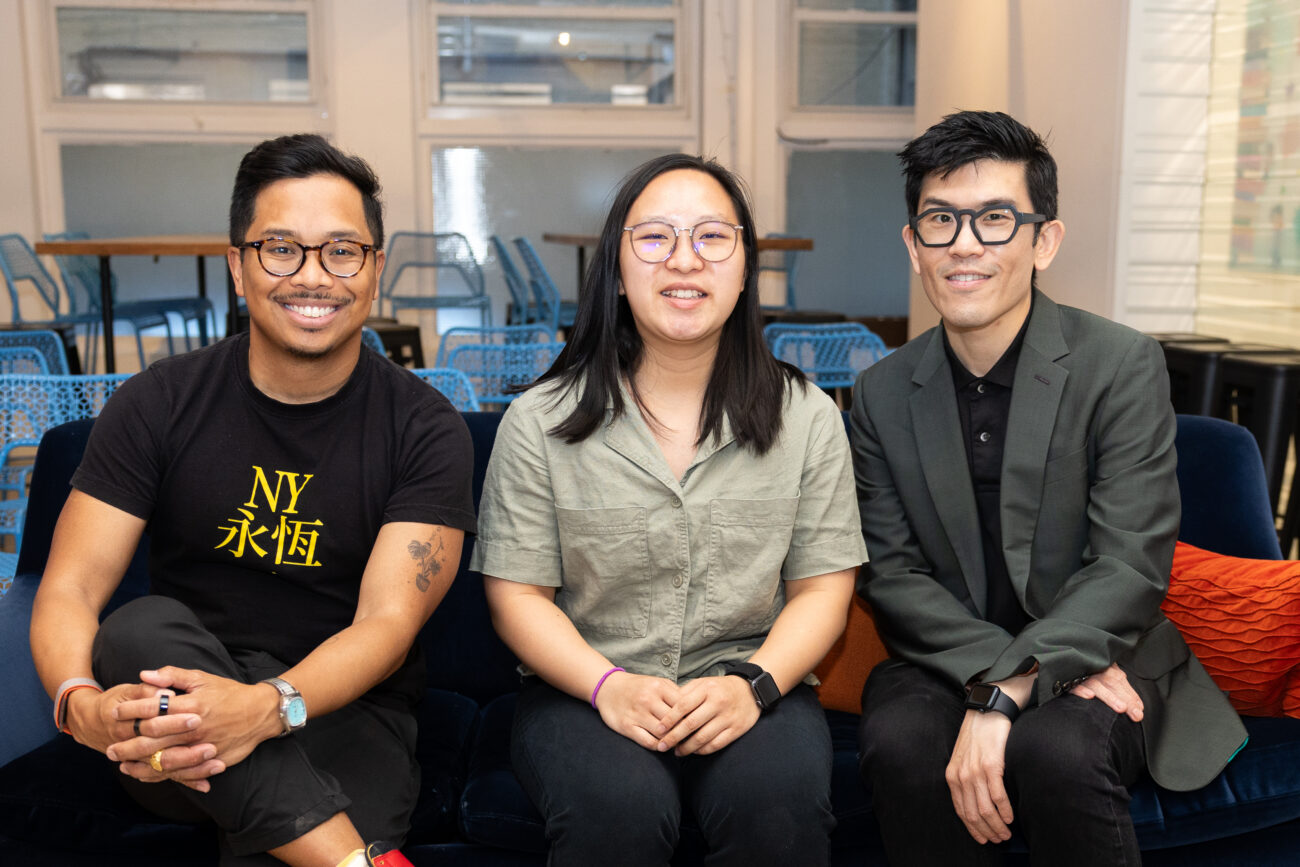
The panel, moderated by Elissa, Apex for Youth Alumni and Baruch College graduate, brought together Bryan Lozano, Chief Strategy Officer at Welcome to Chinatown, and Andrew Tein, Vice President of Strategic Partnerships and Partner Success at Pursuit.
On Their Relationship With AI
How two leaders who help underserved communities keep up with emerging technology, and who approach AI with both optimism and caution.
Q: What is your relationship with AI, and how do you guys use it on a day-to-day basis?
Bryan: “My contention was always that AI is not just destruction, and AI is not just opportunity. I think it’s both things, and how we contextualize that and provide that in safe uses for our communities has been really important for me. So my relationship is a little bit in the middle of where you guys are. Mostly because I see the opportunity, but then recognize the trade-offs and sort of the harms as well.”
Andrew: “My relationship to AI [is] a little bit fraught. Some days, I am feeling really optimistic, or probably over the course of the day, I’ll start optimistic and then be a little bit scared, both for myself and what’s ahead. My professional life has been focused on education, and in particular, education as a means to help people achieve their goals. And a lot of that really came from growing up as a child of immigrants and knowing the role of what that education in place that can play in getting you to where you want to go.
On How AI is Changing the Job Application Landscape
AI-generated resumes are changing the job market by saturating the applicant pool, making it difficult for hiring managers to identify genuine candidates. However, when used strategically, these tools can enhance work portfolios and help applicants highlight their skills while remaining true to their personal brand.
Q: How is the current job application landscape evolving, and what insights should job seekers consider about AI? And how can they effectively utilize AI to enhance their job search?
Andrew: “When a job is posted, the hiring manager at this company or organization is getting flooded with resumes, literally flooded because there’s their AI and other technologies that are sending out resumes, real and sometimes not real.
There’s this volume that recruiting, hiring, and talent teams are dealing with. And I think the implication or the effect is that the typical spray and pray: pressing apply, you’re sending your one resume, does not really work.
Leveraging and building your relationships and social network, which you have access to through Apex for Youth, becomes increasingly important. Your family, your friends, these are important networks today.
But being able to use those relationships for advice, a referral for that job, so that that’s one thing, the importance of your social network is part of your career.”
The Synergy Between AI and Human Efforts
AI can be a powerful collaborator, but it shouldn’t be the author of your story. The panelists describe how the most successful candidates leverage AI to enhance their ideas, improve their work, and brainstorm, while maintaining authenticity at the core of their work.
Bryan: At certain tech companies, like Anthropic, “if you’re using [AI] entirely to answer these questions, create a resume. It’ll be flagged, and you won’t be considered.
The idea here is that you’re augmenting it to support your creative thinking. And I think this is actually a really important aspect in the context of not just the showing and telling, but then how you’re telling the story yourself ultimately. And we’ll talk about this when it comes to best practices, the work that these tools should be doing if you decide to use them, which is important in your own context is that it should be augmenting your your your problem solving skills, your creative thinking, your ability to tell the stories of yourself, your storytelling skills, and your way that you’re projecting yourself out to the world.”
On Avoiding AI Slop
Hiring managers can easily recognize when someone relies too heavily on AI for communication. Our panelists encourage using AI as a collaborative thought partner, rather than allowing it to dominate your writing, which can truly enhance your work.
Andrew: “Have you guys heard the term AI slop? They’re obvious telltale signs– yeah, it sounds good, [but there’s] way too many words, usually, and it doesn’t have much authenticity, which a hiring manager is looking for both on the page and in real life.
But you can use it as your thought partner, right? help you brainstorm with you. ‘Is this job a good fit?’ ‘Is this even a line to my goals?’ ‘What are my goals?’ And take you from start to finish. And then with your initial resume, identify ways to refine it.
But you’re not actually creating the whole thing with AI, you’re using it to refine and build on your starting document.”
Bryan: “There’s definitely a lot of tells when it comes to just AI slop. Generally, the way that it contracts certain words to the way that it even positions some of its just general baseline.
There’s writing that feels very robotic in nature, very AI-oriented.
And I think the way that you’re going to provide authenticity, one, this is really important to develop your writing skills, especially with an English major in the room, like having a voice, being able to understand exactly how you want to be able to articulate yourself. And your story is incredibly important here, because if you don’t have a point of view and you’re not working on your writing skills, it’s hard to then provide a point of view after you ask the AI to do something right.”
On Whether AI Kills Creativity
As AI continues to evolve, its human-like skills continue to improve. Rather than viewing AI as a replacement for human imagination, both panelists explain how artificial intelligence can aid the creative process, stress the unique qualities that set humans apart from machines, and argue for a mutually beneficial relationship that fosters both creativity and innovation.
Bryan: “Creativity is such a loaded word. I just think things are being trained so much more effectively than ever; there’s a lot of nuance to the reason why things are trained so well.
I think we’re moving in this direction of exponential growth, no matter what. So whether we’re going to use the loaded word ‘thinking’ or the loaded word ‘creativity’, these tools are going to be more and more powerful. And its ability to complete tasks in ways that I think humans, especially things like mathematics and SIM, it’s moving faster than anyone has ever really had context to”
Andrew: “A large language model [has] been trained on the vast amounts of language-based data out in public. There is inevitably some baseline outputs that we would say represent creativity and the permutations on the permutations that lead to what creativity is like?
I would like to think the human side in terms of the … grit and the work of creation is still there. Maybe AI enables us to get to a certain level, but how we think about creativity as humans is still a little bit differentiated.”
On Getting Started
How to effectively prompt AI to improve your workflow and thought processes– even as a beginner. Our panelists share insights on utilizing AI resources responsibly and efficiently, outlining the steps you need to take to achieve your desired results while avoiding common errors.
Bryan: “In order to use it effectively, as Andrew said, there are ways to already provide context about you, the way you want to be articulated in your story.
You have a role and a goal. So, the more specific you are when you give AI input, the better, because hallucinations are a thing. You heard of hallucinations? Where it just makes up [things]. Remember, these are programs and technology developed by private companies, and they want you to use the tool more.
So the reason why we do a role in goal is we’re adding context about something like: what is this current prompt supposed to do?
And then we do steps. So when you think of what are the steps that it needs to take in order to get something, remember that there are steps to a task at all times.
And then the last, the third piece, would be output. What exactly do you want the AI to output? What does authentic mean in the context of output? Right? How long is it going to be? What if it’s text-based? And then the last piece that’s actually important in that framework. And then the last piece is eval or evaluation– you’re creating a small layer of checking on the facts, asking it for source material, things of that nature. Double-checking. So then it creates a second loop as you think about the prompt.
Andrew: Easy way to dip in– you should try to challenge yourself. No one sentence prompts, right? Take a minute to think about and provide a little bit more detail. 3 to 4 sentences and even more if you can.
AI is not magic– these are large language models. They have been trained. They are a tool. You have agency. You have control. You are driving the output from the AI tools, and I would say that applies not only in your use of AI, but as you’re thinking about your goals for your education and your career.”
Key Takeaways
- The duality and unpredictable nature of AI. Artificial intelligence offers remarkable opportunities to enhance creativity and productivity; however, it is essential to recognize and thoughtfully address the potential challenges it may pose.
- Access and equity shape how AI is introduced and used. Both panelists emphasize the importance of equity in ensuring that the advantages of automation and technological advancements are shared broadly, uplifting all groups rather than leaving some behind.
- Networking matters now more than ever. As AI diminishes the effectiveness of the traditional “spray and pray” approach, fostering meaningful professional and personal relationships is increasingly valuable.
- Adapting to the age of AI. Embracing AI in the job market fosters a culture of continuous learning and adaptability, motivating students to stay informed on technological advancements.
- Enhancing portfolios through AI. Artificial intelligence can greatly improve your skills and amplify your voice and expertise, enabling you to create a customized resume that truly resonates in your target field.
- AI is a thought partner. Using AI can enhance your ideas and writing; however, it’s crucial to preserve your unique voice and personal touch to stand out among applicants and beyond.
- Like humans, AI makes mistakes too. While AI can certainly improve efficiency, it cannot mimic the unique voice of individuals shaped by their personal experiences and stories. Furthermore, since AI is prone to errors and hallucinations, careful review of its outputs is essential to ensure quality and reliability.
Stay Connected with Apex for Youth For More Events
This panel was part of Apex for Youth’s Career Exploration Panel.
Watch the full series on YouTube:


 Vietnamese
  English
  Chinese
  Korean
  Bengali
  Spanish
  Tagalog
  Hindi
Hindi