
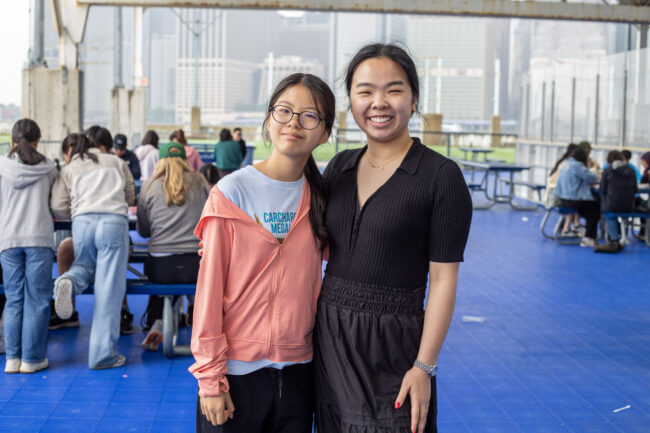
At Apex for Youth’s Creative Career Panel, moderated by alum Hebe, two artists shared their journeys. Emily Xie, who spent a decade as a software engineer before walking away to make art full-time, and Chloe Flower, who spent 10 years being told her music was “too edgy” for classical and “not pop enough” for pop, until her collaboration with Cardi B proved otherwise.
The Jobs Before the Art
Long before gallery openings and sold-out performances, both women worked jobs unrelated to their current careers.
Q: What was your first job?
Emily: “Even though I’m an artist right now, my first job was in tech. I actually built a career as a software engineer for about a decade before becoming a full-time artist. My first job was actually a product manager at an art auction startup company, and my last was working in AI at X.”
Chloe: “My first real job was as a waitress. I was a waitress at the coffee shop in Union Square when it was open. I wasn’t really allowed to have a job; my parents wanted me to practice all the time and not work. So I never collected my paycheck. I just had tips. It was actually crazy. I didn’t want to get in trouble, you know?”
Self-Doubt as Fuel, Not an Obstacle
Perhaps the most striking thread of the conversation was how openly both women discussed insecurity, not as something they’d overcome, but as something they’ve learned to use.
Q: Were there things you did in your careers that built up confidence to stand firm in who you are as creatives?
Chloe: “I think kind of rejecting confidence in a way, I was totally my whole career filled with self-doubt. I was told for ten years, up until the Cardi B performance, ‘we don’t get it, it’s too edgy, it’s not classical, and it’s not pop, so what is it?’ And I think that self-doubt is what really gave me the drive to just keep trying.”
Emily: “I love what you said because I get where you’re coming from, that constant self-doubt really does push you to practice more, prepare more. It is kind of a lifelong struggle in this profession. Sometimes I don’t feel like this is the right thing for me to be doing right now. But that lack of confidence in a given moment kind of builds confidence over time.”
Q: How do you think about certainty versus uncertainty in your creative process?
Chloe: “The certainty, that aspect of being so sure that something’s going to work, can often kill creativity, because when you’re so certain about an outcome, you’re not desperate to seek out new ways of doing things. So for me, embracing the unknowing and embracing the uncertainty was really an important part of my development as an artist.”
Emily: “I find the same for me, too. The creative process is so random, right? And so when you’re seeking an endpoint, it is a creativity killer. What I begin with in my head and what ends up being produced is just wildly different, and leaning into that has been very helpful. There’s confidence in leaning into the uncertainty.”
The Real Cost of Making Art a Career
Once art stopped being a hobby and became their livelihood, both women said the dynamic shifted in ways they hadn’t fully anticipated.
Q: What are the challenges you face as artists?
Emily: “I found that really difficult when I switched from art being this huge hobby of mine to art as a full-time job. That pressure, that tension of what you make now is like your income and your ability to live day-to-day life depends on what you’re creating, it actually changes the dynamic. It makes art-making a little bit more stressful for me.
Chloe: “I think the biggest challenge for me right now is this tension between what we want to create as art and what is going to be commercially successful to support us. I can’t write anything for TV that’s more than three minutes and 30 seconds, and in classical music, I don’t even have time to get to where I want to go. But it’s also a beautiful thing, it allows me to step outside my comfort zone and create something I think people will like.”
Heritage as Both Wound and Wellspring
The conversation became more personal when it shifted to identity.
Q: How does being Asian American shape your professional careers as artists?
Emily: “A lot of my artwork explores my Asian American heritage. I grew up in rural Maine, where my family was one of the very few Asians in town, so I had this difficulty with my heritage growing up because, on one hand, I really wanted to assimilate. I lost my ability to speak Chinese simply because I refused to speak it. It’s one of my biggest regrets to this day. In my art, I find ways to reconnect with my roots by exploring symbolism in Chinese culture and characters. As an adult, I’ve really gotten to appreciate my Chinese culture in a way I wasn’t able to as a kid.
Chloe: “I grew up in an all-white town, and I was one of two Asians in my school. I saw that as not fitting in, as a negative thing. But as I grew up, I realized it’s actually a superpower; it’s made me who I am as an artist today. I had never learned a piece of music written by a woman, and there hasn’t been much repertoire of Asian composers, Asian female composers, or even Asian male composers. That really inspired me to want to become a composer, and to show other Asians that we can be conductors, we can be composers, we can be soloists.”
Building Community in Underrepresented Spaces
Both panelists acknowledged that Asian American representation in their respective fields remains thin, particularly in the visual arts.
Q: How do you take space and create community for yourself and others?
Emily: “I’ll be honest, I feel like there’s not a ton of Asian American visual artists, so I have a couple of friends, and that’s a strong community for me. I think part of it is because, as an immigrant from China, my parents immigrated all the way here for better opportunities for their children, so the idea of even being an artist is kind of sacrilege; they wanted me to pursue the traditional path, like engineering or being a doctor or lawyer, and live a stable life. When you do find those few in your community, really hold on to them and value that, because their perspective resonates with yours so much.”
Chloe: “I think finding people and social media is actually great for that. I’ve built such a strong community of Asian friends from social media. I now surround myself with female composers, which is really important to me. And it doesn’t have to be people who do exactly what you do, I’ve become friends with so many Asians in fashion and photography, things that are peripheral to what I do, and you learn a lot from that.”
On Burnout, and What Comes Next
On burnout, both offered grounded, almost unglamorous advice about knowing when to push and when to step back.
Q: How do you navigate periods when nothing is sparking creatively?
Chloe: “Art isn’t something you can really quantify, that’s probably why it’s hard to get funding for the arts. You don’t see the spiritual evolution that happens from learning in a group setting. I think just embracing the fact that it doesn’t always have to be amazing every single time, because it’s just not going to happen, and accepting that is a really important part of the process.”
Emily: “For me, it’s like a combination of touch grass – disconnect, go offline, take in the world. Having dedicated time every day to see some progress is helpful, but if you do that too much, you burn yourself out. So it’s a combination of knowing when to lean in and lock in, and when to step back. That’s an intuition that develops over time, because towards the beginning of my art career, I really locked in and kind of burned myself out, and that sets you back.”
Q: How do you navigate the uncertainty of building an art career in today’s job market?
Emily: “You have to lean into uncertainty, I think that’s the only thing we can do in this environment with AI revolutionizing everything as we know it. So just put yourself out there, and the world will come to you. Find something that will pay the bills while you work on your own interests as a hobby. While you aren’t getting paid for your hobby, you are creating your portfolio for yourself.”
Chloe: “If you add up all the hours I worked for free, right now I’m at like negative $1,000 an hour. But you have to identify what will elevate you and your career. There’s no wrong path, really, everything is a learning experience, and it might not always be paid, but the experience could be really valuable.”
Key Takeaways
- Certainty can kill creativity. Flower and Xie independently arrived at the same idea: being too sure of an outcome removes the urgency to explore, while leaning into the gap between what you imagined and what you made is where the real process happens.
- Heritage once suppressed can become a creative wellspring. Both grew up trying to assimilate in predominantly white towns: Emily stopped speaking Chinese, Chloe downplayed standing out, and both later turned that same heritage into a defining part of their work and identity.
- Community doesn’t have to mirror your exact craft. Both found support through social media, other female composers, or creatives in adjacent fields like fashion and photography; proximity of experience mattered more than doing the same work.
Stay Connected with Apex for Youth For More Events
This panel was part of Apex for Youth’s Career Exploration Panel.
Watch the full series on YouTube:

 Hindi
Hindi  English
  Chinese
  Korean
  Bengali
  Vietnamese
  Spanish
  Tagalog