

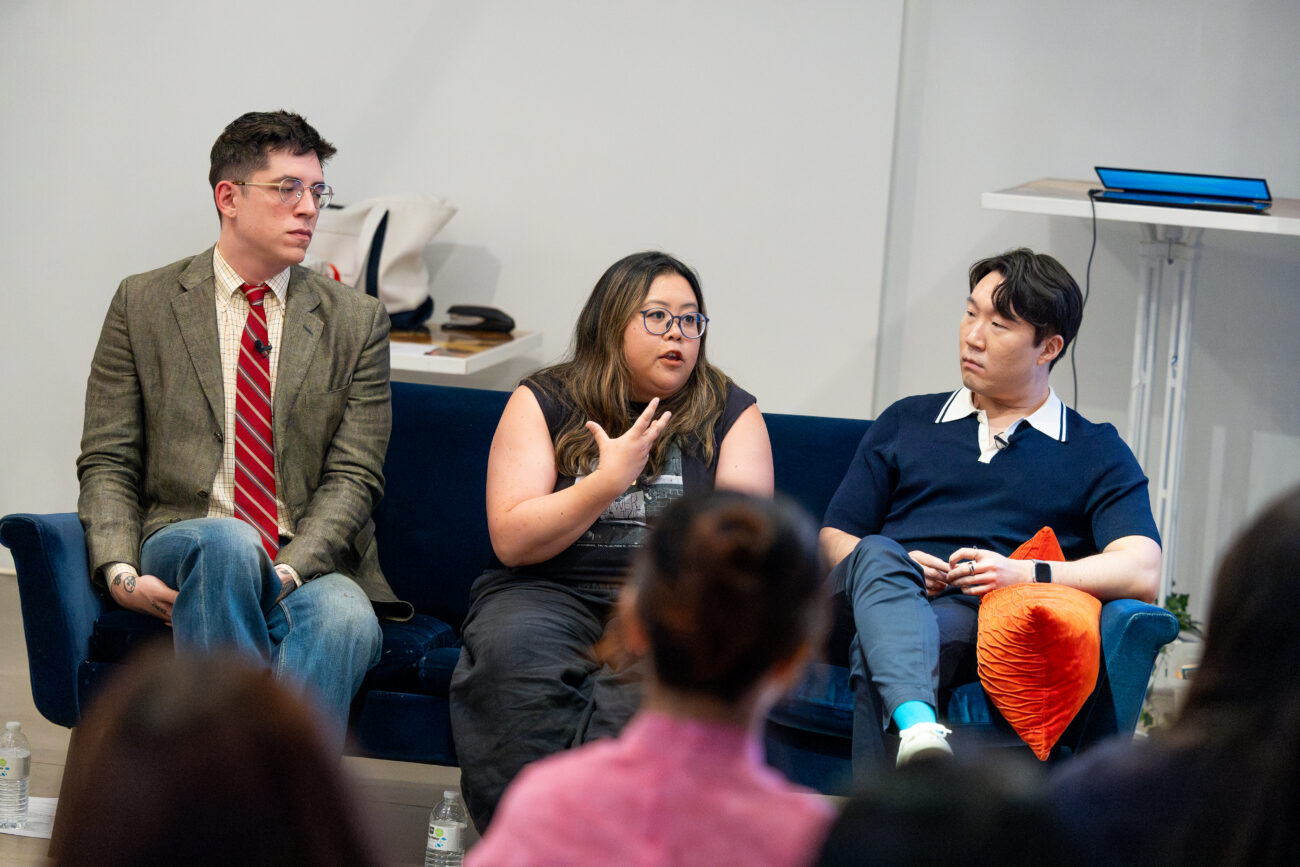
At Apex’s College Career Connection event, three professionals gathered to talk about something that doesn’t come up enough in career conversations: What it feels like to walk into a room carrying identities that the room wasn’t necessarily built for.
The panel, moderated by Miki, Apex for Youth Alumni at Mount Holyoke College and resident advisor for the BIPOC Forum, brought together Do Hee Jeong, senior product counsel at SeatGeek; Kim Thai, Director of Marketing and Communications at Apex; and Maxwell Losgar, Senior Director at Hearst Magazines.
On Stereotypes and Showing Up
Walking into a room where people have already decided who you are before you speak.
Q: When have you been read one way, but proceeded in a way other people couldn’t see? How have you challenged those stereotypes walking into a room?
Kim: “I’m very outspoken and very loud with my voice. But I think often that is not expected from an Asian woman — we’re expected to be more quiet. So I’ve been very intentional, especially in more corporate spaces, making sure if someone doesn’t give me a seat at the table, I’m making a seat at the table myself. And creating more space for women of color in the room is something I’ve really tried to do with my career.”
Do Hee: “There are definitely a lot of stereotypes, whether conscious or unconscious, where the model minority myth really comes into play. People have expectations of how Asians are — we’re hardworking, we keep our heads down, we don’t ruffle feathers. I’ve always carried that in the workplace and considered whether my actions are breaking those stereotypes or buying into them.”
On Tokenization and Being “the Only One”
What happens when you’re the sole representative in the room, and the invisible work that comes with it?
Q: You briefly mentioned being the only person in the room. And that comes with a lot of tokenization. How do you deal with that, and how do you work toward creating a safe space for people coming after you, and making sure that labor is recognized?
Maxwell: “As you work your way up the ladder, it does often get whiter and more male. There are moments where the labor falls on me as the person closely aligned to speak on behalf of all my colleagues. It’s an uncomfortable burden — something I just have to either take on, or kindly explain to the folks that it’s not my place. Unless you have a seat at the table, you won’t make a difference. So when you have the seat, you have to figure out how to use it.”
Kim: “A huge part of my career has been uplifting other women of color. I was at MTV for a really long time, and when I first started, it was me and one other woman of color in the entire department. I had this secret mission that I was going to change everything. On one of my last days there, I looked around and half the room were women of color. I started crying at my going away, because it was just such an intentional piece of work.”
On Safety and Knowing When to Show Up
Reading the room before deciding how much of yourself to bring into it.
Q: How do you determine safety? How do you determine whether or not to come out, or to share more of yourself and who is safe enough to show that to?
Kim: “It’s a really big skill to be able to read the room — you almost trust your gut instinctively. If the space feels warm, if people are smiling, you can feel like you can be a little bit more yourself. I also think sometimes it’s nobody’s business. I’m here to work, I’m here to show up and do the best that I can. Me showing up as my authentic self is a privilege for other people to witness.”
On Bringing Your Whole Self to Work
The idea of a fully integrated “whole self” gets complicated when that self is still under construction.
Q: What does it mean to bring your whole self to work when your whole self is still in practice when you’re still coming to terms with your identities?
Do Hee: “I think it’s deeply personal, and it’s very seasonal. The 16-year-old me and the identities I ascribe to are very different from the identities I subscribe to today. I think as humans, it’s in our nature to want to fit into whatever community you’re in — the persona you bring to your friends, your parents, your coworkers are very different, and I do believe all of those are versions of yourself. Over the years, I’ve given myself more grace for not feeling terrible about that.”
Maxwell: “I would say I like what you said about seasonality, bringing your whole self all the time to all people would be a lot. Not having shame in adjusting is key to self-preservation. There are parts of myself that I can reveal to certain people who’ve earned it, and others who don’t necessarily deserve it. That doesn’t mean I’m hiding.”

On Allyship – Giving and Receiving It
Allyship isn’t abstract — it shows up as specific people doing specific things at specific moments.
Q: You mentioned briefly about people being there for you — having found allyship with somebody, or having been an ally. Can you share a moment of that?
Maxwell: “When I was at Condé Nast, I was 25, and it was the year gay marriage was legalized. Me and a few other queer folks sent an email to our HR representative to make sure that all the benefits offered to us as employees for our spouses would be implemented effective immediately. Leadership had sort of assumed it was a given. It meant a lot to all of our queer colleagues at the time — that was one of my moments.”
Do Hee: “One of my best mentors also happens to be AAPI identifying. I think finding mentors in the workplace is super important, especially people from similar cultures and backgrounds. He had a very similar career trajectory — also Asian American, grew up in New Jersey — and he gave me a lot of coaching on how to raise my voice, how to lean in, how to speak up, how to break through that glass ceiling in a corporate setting.”
On Advice for Future Mentors
Everyone will be a mentor to someone eventually — here’s what they’d want that person to know.
Q: Everybody in this room is going to be a future mentor to somebody. What advice would you give them on how to be a mentor — right now?
Maxwell: “I’m constantly telling my grad students — authenticity is key to carving out a voice for yourself in this packed digital landscape right now. Stop caring as much about what your peers think, and start thinking about what the gatekeepers think, because they are the ones who are going to tap you when the time is right.”
Do Hee: “Listen to yourself. It took me so long to realize what I even wanted and what I liked. My advice for people who are younger is to really listen to yourself, find what you love, and find what you’re really good at. People who are happiest and feel fulfilled are people who really know themselves.”
On Knowing If You’ve “Made It”
Spoiler: even people who look like they’ve “made it” aren’t sure they have or that the concept means anything.
Q: You must think you’ve made it. How do you know if you’ve made it? Have you made it?
Maxwell: “It’s a constant journey. I do often remind myself that my younger self would be so proud of where I am. Anytime I’m comparing myself to colleagues who are the same age or have a higher salary or bought a house, I remind myself — that’s their journey. I am enough.”
Do Hee: “I was in Thailand for two weeks, away from friends, family, and work, partly to consider relocating to Asia. What I came back with was, I have so much here in New York. I actually feel very full with what I have now. I just want to give myself grace to really take a breath and appreciate the things I have.”
Kim: “I had this very arbitrary goal to become a VP by 30. I got there at 31, and I was the unhappiest I had ever been in my career. I came across this concept called Arrival Fallacy — the idea that you work so hard to get somewhere, and when you get there, you realize it’s not at all what you wanted. Making it to what? Making it to whom? To where? The idea of making it is so false.”
On Speaking Up When It’s Risky
Knowing your truth and knowing when it’s safe to say it out loud are two very different skills.
Q: Given your identity, have you ever found yourself really disagreeing with something in the workplace and not being able to speak your truth — or feeling limited, given your identity?
Maxwell: “When I first got into publishing, diversity was quite literally treated as a box to check. I had to call out the fact that we weren’t doing the same thing for our white castings. If we had three white girls in a row, no one was saying we already did a white girl. So if that’s the metric, we need to meet our white casting decisions with the same energy.”
Do Hee: “I would say they weren’t blatant racism, but a lot of microaggressions. I remember a client on a call who realized I was Asian and said, ‘Oh, you’re very good at English.’ Those are moments where you choose — do I confront this, or do I move on? I choose not to confront it sometimes. It’s the operational cost of being a person of color in those workplaces. It’s about knowing how to read the room and calibrate whether that’s the right battle to pick.”

Key Takeaways
- Authenticity is situational, not absolute. All three panelists pushed back on the idea of one fixed “whole self” — Do Hee called it “seasonal,” Maxwell called adjusting “self-preservation,” not concealment.
- Visibility comes with unpaid labor. Being “the only one” in a room often means informally representing an entire group, something Maxwell described as a burden to either accept or push back on.
- Mentorship works best within shared experience. Do Hee’s strongest mentorship came from someone with a near-identical background; Kim made deliberately diversifying her team a personal mission.
- “Making it” is a moving target. All three independently arrived at the same conclusion — that external benchmarks (VP titles, salaries, relocating) don’t deliver the satisfaction they promise.
- Picking battles is a skill, not a compromise. Both Do Hee and Maxwell described consciously deciding when to confront bias and when to let it go — framed as calibration rather than avoidance.
Stay Connected with Apex for Youth For More Events
This panel was part of Apex for Youth’s Career Exploration Panel.
Watch the full series on YouTube:

 Bengali
  English
  Chinese
  Korean
  Vietnamese
  Spanish
  Tagalog
  Hindi
Hindi