
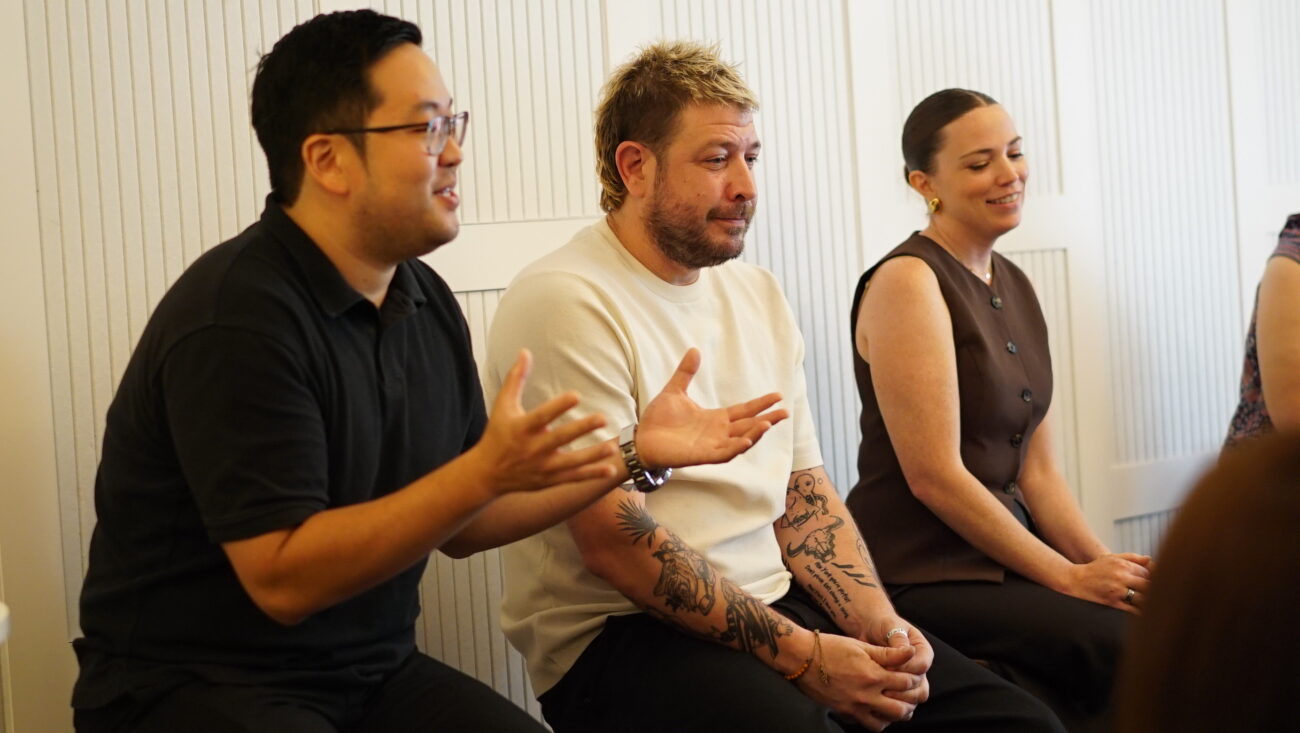
Working in hospitality involves more than just handling food; it requires being a team player, adapting to changing environments and global events, and ending up in a career you never planned. At Apex for Youth’s Hospitality Career Panel & Networking Lunch, three leaders from 55 Hospitality shared their journeys in hospitality.
None of you set out to build the careers you have now. How did you end up here?
Dustin: I opened my first restaurant at 24. Had seven of them, sold them, lived a life, and then decided I wanted to start cooking instead. I never went to culinary school. I started as a line cook in New Orleans, knocking on doors until someone finally believed in me.
Hoon: I studied advertising, then worked at an investment company for a year. Staring at a monitor twelve hours a day was so boring. I quit without telling my parents and started working in restaurants instead.
Morgan: I started as a busser at a hometown place when I was 14. Anytime I thought I was going to leave the industry, I got dragged back in. I never made a conscious decision to go into hospitality as a career; it just naturally happened.
What does “culture” actually look like inside a restaurant, day to day?
Dustin: No matter who it is, I say hi and I say bye to every person on staff, dishwasher, porter, front of house, back of house. I’m terrible with names, so I have to relearn them constantly, but I make the effort. If they know I care, they’re going to care about what they’re cooking and who they’re serving.
Morgan: If a server calls out for a shift, everyone else feels it. When someone’s in the weeds, you jump in, you help run water, you support them until they’re settled, and you know they’ll do the same for you later.
Hoon: A restaurant only works as a team. You’ll always run into people who think they’re superstars, never late, never make a mistake, but without support, you’re not winning.
You compared hospitality to a team sport. What did you mean by that?
Hoon: During service, you always have to pivot. If service ever goes too smoothly, something feels wrong to me. If I don’t get a phone call during a shift, I’m more anxious than if I get a hundred. That’s actually what I love about it: the people who thrive are the ones who don’t panic when problems hit.
Dustin: It’s like building a roster. I know Fridays and Saturdays are our primetime games, so those days I need my A-team on. Newer team members get reps on quieter nights. If one person is struggling and no one helps them, I get more frustrated with the rest of the team than with that one person because everyone has an off day.
Dustin, you learned to cook Thai food from scratch well into your career. What was that like?
Dustin: They probably sent back forty dishes to my face in the first six months. It wasn’t that the food was bad; it just wasn’t traditional Thai, and they were having trouble explaining what was missing. Eventually, I told them I needed to go to Thailand. I was there for two and a half months on my own, just traveling and eating, and things started to click.
I was eventually connected with a teacher who didn’t teach me with recipes; I already knew how to read a recipe. She taught in a staircase method: first days on history and culture, because if you don’t understand the culture, you’re not really cooking that food. Then she’d hand me a dish and say, “I want it one step more sour, one and a half steps less salty,” and have me adjust from there.

What advice would you give someone just starting out, trying to figure out their own path?
Morgan: One of the most important things when you start managing people is recognizing everyone’s emotional intelligence; you can’t discipline or give feedback to every person the same way, because people respond differently. Someone once told me: you can loosen the leash, but you can’t tighten it. Go in a little firmer at first, then ease back over time.
Dustin: Early on, I tried to be the yelling chef, because that’s “what chefs do,” and it never got me what I wanted. The moment I stopped forcing that and stayed true to myself, things clicked. No one can hand you a formula for how to manage; you have to find what actually works for you.
Hoon: What really grew me into my role was constantly asking myself, “If this were my restaurant, what would I do?” That became my mindset the moment I became a manager. My biggest piece of advice: whatever you’re thinking of trying, try it. If it doesn’t work, that’s okay; try again, try something else.
What’s stuck with you most from your time here?
Dustin: Finding the right people to work with, whether that’s partners, investors, or your team, might be the single most important thing in this business. I’m done searching. I found my partners and my restaurant, and now it’s about growing it together.
Hoon: We don’t even think about it being a day off or a weekend; we just figure it out together. That’s what makes it click.
Morgan: It also helps that we all started at the very bottom. It gives us empathy for where our servers, bartenders, and cooks are coming from, because we’ve been there.
Key Takeaways
- None of these leaders planned their careers. A restaurant owner became a line cook. A banker became an operations director. A busser became a director of events. Their paths prove there’s no single “right” way into hospitality, or any career.
- Culture is built before the guest ever sits down. For Dustin, it’s learning every name on staff. For Morgan, it’s covering a teammate without being asked. Culture isn’t a policy; it’s a hundred small decisions made when no one’s watching.
- It’s never too late to start over. Dustin spent 25+ years cooking before relearning an entire cuisine from scratch, in his mid-30s, by flying to Thailand and starting as a student again.
“I appreciated how candid the panelists were; they shared vulnerable aspects of their lives and careers, including how they had to pivot in response to factors beyond their control. Hearing that even individuals this far along in their careers are still learning and willing to start over made their journeys feel much more realistic and less intimidating as I reflect on my own path.” – Leilani, Apex for Youth Marketing Intern
“Hospitality is often seen as a plan-B or fallback career, but for each of our panelists it was something they intentionally pursued. As I designed our Professional Developments Workshops, I want our youth to feel empowered to define success on their own terms, rather than defaulting to conventional expectations.” – Marina Karnofsky, Career Exploration Program Manager
Thank you to Dustin Everett, Hoon Kim, Morgan Mohally, Fish Cheeks, and 55 Hospitality for welcoming our students and sharing your stories with such honesty.
Apex for Youth’s JT Tai Internship Program provides our high school and college students with a paid internship at a matched company. This internship program provides meaningful work experience for our young adults and gives them the chance to develop professional skills, explore new careers and industries, and learn from trusted, supportive professionals.

 Korean
  English
  Chinese
  Bengali
  Vietnamese
  Spanish
  Tagalog
  Hindi
Hindi