
As the year winds down, many people feel drawn to give back – to express gratitude, help others, and end the year on a hopeful note. But year-end giving isn’t just emotionally meaningful; it can also be financially strategic, especially if you’re navigating a high-income year or planning long-term charitable goals.
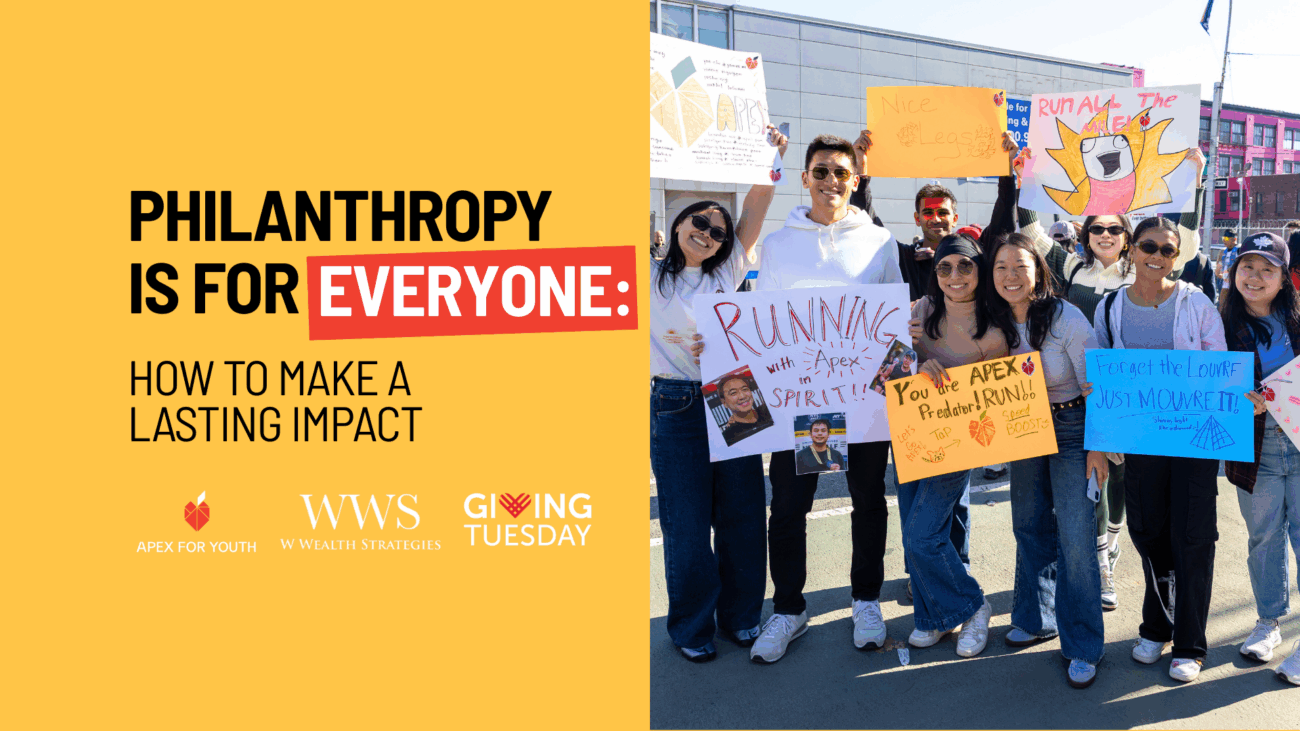
During a recent Apex for Youth webinar, “Philanthropy is for Everyone: How to Make a Lasting Impact,” financial planner Kyle Wong, CFP®및 사브리나 후아, Associate Director of Individual Giving and Special Events at Apex for Youth, shared practical guidance on how anyone, regardless of wealth, can make their giving more intentional, impactful, and tax-efficient.
This guide walks through the why, the how, and the strategies that can help donors make the most of their generosity at year’s end.
Why should you consider year-end giving to charitable organizations?
- Offsetting a High-Income Year
If you’ve earned more than expected through bonuses, stocks, or investment gains, charitable giving can help offset taxable income. Strategic donations, especially before December 31st, can meaningfully reduce your tax bill.
- 그리고 Spirit of Goodwill
During the holidays, the spirit of gratitude and generosity shines brightest. Many donors discover that giving at this time of year, when reflection and community take center stage, leaves them feeling more hopeful, fulfilled, and connected.
4 Strategic Year-End Giving to Maximize Your Impact
- Cash Contributions
The most straightforward way to give is through cash contributions, which provide an immediate tax deduction for those who itemize. Donors are encouraged to check whether their employers offer matching gift programs to amplify their impact. For example, a $10,000 donation in the 24% tax bracket results in $2,400 in tax savings, reducing the net cost of giving to $7,600. - Qualified Charitable Distributions (QCDs)
For individuals aged 70.5 or older, QCDs allow donations directly from an IRA to a qualified charity, counting toward required minimum distributions without increasing taxable income. QCDs can also fund Charitable Gift Annuities, providing a lifetime income and tax benefits. - Donor-Advised Funds (DAFs)
Ideal for donors with stock or investment accounts, DAFs allow an immediate tax deduction while enabling the fund to grow over time before recommending grants. For instance, donating $10,000 of appreciated stock with a $2,000 cost basis in a 24% tax bracket could save $2,400 in federal taxes and avoid $1,200 in capital gains, leaving a net donation of $6,400. - Advanced Giving Options: For high-net-worth individuals, advanced strategies include:
- Charitable Gift Annuities – Provide fixed income in exchange for a donation.
- Charitable Trusts – Such as Charitable Remainder Trusts (CRTs) or Charitable Lead Trusts (CLTs) for larger estates or appreciated assets.
- Donating Appreciated Assets, Life Insurance, or Real Estate – Enables strategic giving while optimizing tax benefits.
- These options are particularly relevant for individuals with significant stock holdings, business ownership, or high-income years.


How to approach your charitable giving:
Step 1: Assess Your Financial and Tax Situation
Kyle Wong emphasized the importance of examining your financial picture before making commitments:
- Are you itemizing deductions or taking the standard deduction?
- Will next year be higher or lower income?
- Are there appreciated assets in your portfolio?
- Are you approaching age 70½, when IRA strategies become available?
Step 2: Create a Multi-Year Plan:
If your goal is to lower taxable income through charitable giving, think beyond a single year. Look at your expected earnings over time and decide when it makes sense to give more, whether through cash, donor-advised funds, or appreciated stock. Spreading out or strategically timing gifts can reduce taxes while maintaining steady support for nonprofits.
Kyle Wong emphasized: “Giving should be intentional, rooted in your goals, not just reacting to the moment.”
Step 3: Decide Where to Donate Money:
Once you know how much you want to give and which strategies best suit your financial picture, the next step is choosing where to direct your generosity. Many people look for:
- alignment with their values,
- transparency in how donations are used,
- measurable impact
- communities that are underserved or underfunded.
How to Decide Where to Donate Money
As you consider where your generosity can genuinely make a difference, 청소년을 위한 에이펙스 is one example of a charity to support. Apex empowers Asian American youth from low-income and immigrant backgrounds to unlock their potential today and a world of possibilities tomorrow. Despite representing 18% of the city’s population, Asian American communities receive less than 1.5% of social service funding, leaving many young people without the support systems they need.
Key Statistics: Asian American Youth in NYC
- 18% of NYC’s population is Asian American, yet the community receives less than 1.5% of social service funding.
- 1 in 4 Asian American youth lives in poverty.
- 1 in 5 lives in a home where no one over age 14 speaks English, creating challenges in education, opportunity, and integration.
How Apex Makes An Impact
- Apex is one of the largest organizations in the U.S. serving primarily Asian American youth.
- With nearly 1,000 volunteers 그리고 5040 staff, Apex serves more than 2,6002,500 youth each year in NYC and across the country.
- 100% of Apex 12th graders graduated high school within four years.
- 92% of Apex high school seniors graduated and enrolled in college.
- Apex delivered over 2,500 hours of programming and services in FY2024.
- As college graduates, 52% of Apex alumni are more socioeconomically stable than when they were growing up.
This Giving Tuesday, join Apex for Youth in creating a world of possibility, where every young person has transformative relationships and access to resources to grow with agency, belonging, and confidence.
Act now to double your impact:
Thanks to a $20,000 matching fund, every gift made through December 7th will be doubled, supporting more than 2,600 Asian American youth from low-income and immigrant families.


 Korean
  English
  Chinese
  Bengali
  Vietnamese
  Spanish
  Tagalog
  Hindi
Hindi