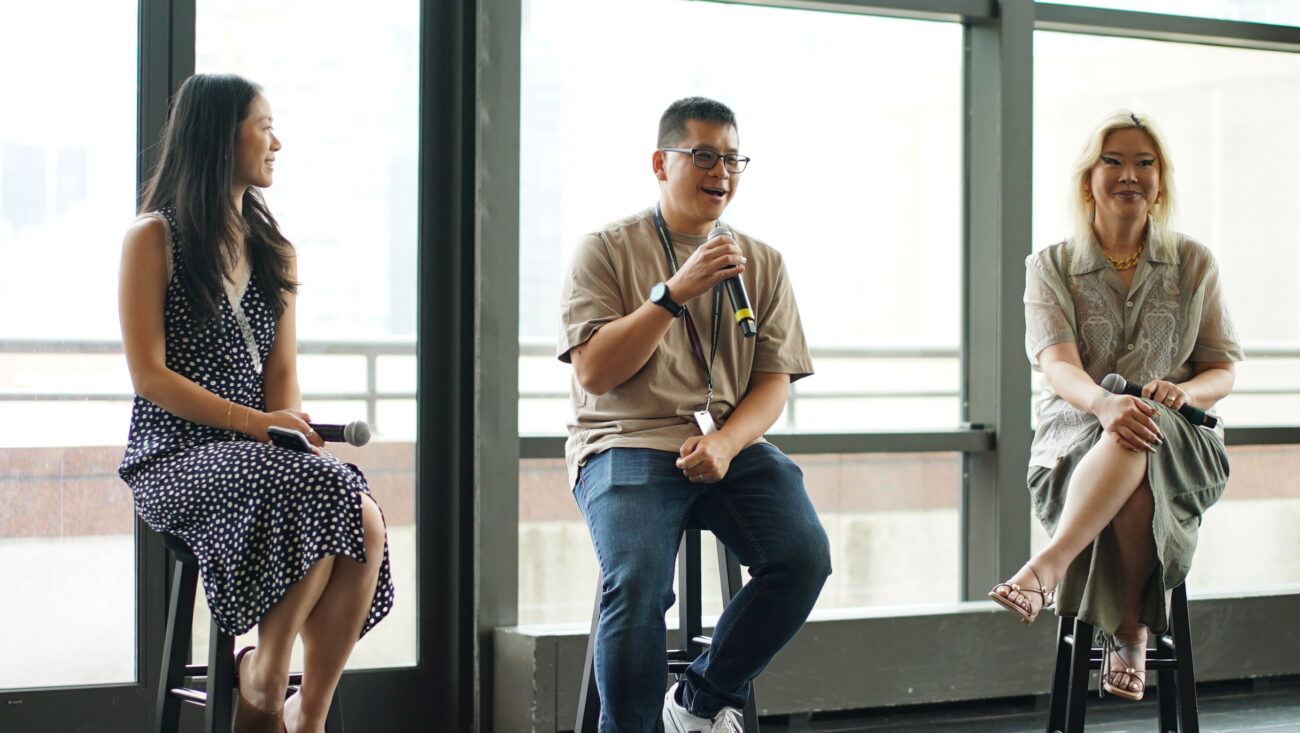
Entering the workforce means more than landing a first job; it means learning how to build relationships, ask for help, and find work that feels purposeful. At Apex for Youth’s Lincoln Center Career Panel, three leaders from one of the country’s largest performing arts institutions shared how they navigated their own winding paths into the industry.
The panel brought together Alex Cheung, Senior Recruitment Manager at Lincoln Center; Genevieve Ferris, Cross Campus Fundraising Senior Manager at Lincoln Center; and Siobahn Sung, SVP of Artistic and External Affairs at National Sawdust and former Senior Producer and Curator at Lincoln Center for the Performing Arts.
On Early Resources and Community
Before formal internships or mentorships, community spaces often provide the first foothold into a career. Siobahn describes how growing up in a single-parent household meant that libraries, extracurricular groups, and tight-knit cultural communities became her earliest professional resources.
Q: What resources did you rely on early in your career, and how did your community shape your path?
Siobahn: “When we look around the room and see all these beautiful Asian faces, we know that we are not a monolith; there are many different kinds of stories in this room, many different kinds of family structures, different intersections generationally across our families and our care structures. I grew up in a single-parent household with my father, in England, and then came to the U.S. as a teenager. So much of my resources came through community, extracurricular groups, my public library, and later the productions and companies I worked for became my community in a transient way.”
On First Jobs
Long before their current titles, each panelist held first jobs that shaped how they communicate, manage time, and work with others, lessons that carried directly into their careers today.
Q: What was your first job, and what did it teach you?
Genevieve: “I was a dancer growing up, so I ended up being a counselor at a dance camp for young children. It was really great to harness my passion for dance and share that with the next generation. From that job, I learned how to be a better communicator and how to work on my time management with kids and adults.”
Alex: “My first job was at McDonald’s in high school. I did everything from cashier to making burgers. I took the communication and relationship management skills from that, having to build rapport with customers who came in every day, and applied them as I moved forward in my career.”
On Internships and Getting Your Foot in the Door
Not every panelist’s path ran through a formal internship.Some panelists built their own version of an internship through hands-on involvement in local organizations; others found theirs through a law firm or nonprofit; and some leaned on networks of people who’d been there before to find the right fit. Whatever the route, each experience shaped how they’d approach their career from then on.
Q: How did you find your internships, and how did they shape your career path?
Siobahn: “I never had an internship, but in that same spirit of community, I always tried to find a place within any organization where I could spend time with the people making the influential decisions, whether that was helping produce a community talent show, getting involved with a neighborhood garden, or joining my block association at fifteen. Those were my version of internships.”
Alex: “My first internship was at a law firm, in a business center supporting paralegals and legal assistants with everything from Excel spreadsheets to case documents. My second was with an organization called Liberty in North Korea, where I did grassroots fundraising and traveled the country giving presentations. That experience really tested my public speaking, and if you hate public speaking, I think the only way to conquer that is to just continuously do it until you can.”
Genevieve: “I had two internships in college. I used my network of older students who’d interned before me to figure out what to pursue. My first was at a small dance studio, where I wore a lot of hats – front desk, social media, teaching classes, even managing budgets. My mentality was to jump in and do whatever was needed, being the first to volunteer to help. My second internship was at the Kennedy Center, which I found by applying online, and that experience is really what guided me to where I am today at Lincoln Center.”
On Career Pivots and Unrelated Past Roles
None of the panelists arrived at their current roles in a straight line. Teaching abroad, corporate IT work, and fundraising for different causes all became stepping stones, proof that skills transfer even when industries don’t.
Q: Tell us about a job or experience that isn’t directly related to your current role. What skills did you carry forward?
Alex: “I majored in Information Systems Management and international business, so I have nothing to do with recruitment on paper. I spent a year and a half as an IT analyst in corporate America, and it wasn’t the most satisfying work. I wanted to help people, so I explored the Peace Corps and landed a two-year assignment in the Philippines as an educational volunteer, teaching myself an entire curriculum for a computer lab the school had been given with no support. From there I moved into recruitment marketing, then found a mentor who taught me full-cycle recruitment. Each step lets me harness a parallel skill, especially relationship management and communication.”
Genevieve: “I’ve always been in fundraising but shifted between departments from individual giving to corporate sponsorships. I also worked at Girls Who Code, which is obviously different from the performing arts, but it widened my scope of what a nonprofit could feel like, more like a tech startup. At the end of the day, it’s about relationships, building and managing them. Even with a corporation, you’re speaking to the individuals there.”
On Asking for Help
Asking for help can feel like a burden, especially early in a career. But all three panelists agreed that it’s one of the clearest signals of growth, and something hiring managers notice.
Q: When has asking for help made a difference in your career?
Genevieve: “I don’t like to think it takes forever to ask. I’ve found it most helpful to just go straight to the source and ask the expert. You shouldn’t be afraid to ask questions, especially early in your career. People are really receptive to it. It shows you care and are thinking about how you can grow in your role.”
Alex: “Asking questions is scary. When I was in the Philippines, it took a lot of courage to ask someone to help me with the language, even though I knew they had their own obligations. Later, I had a mentor who taught me full-cycle recruitment, and even though she was directly teaching me, I still had to ask a lot of questions about things like confronting bias in the hiring process. Don’t be afraid to ask for help; it shows people you care and are thinking about how you can grow in your role.”
Siobahn: “The answer that came to mind was, every damn day. In order to ask for anything, you have to know what you want, and you have to make it known what you want, because nobody else is going to do that for you. How you ask and what you ask for is what informs people of who you want to be in that space.”
On Building Confidence
Confidence, the panelists agreed, comes less from titles and more from showing up authentically and from resisting the urge to borrow influence from whoever holds the most power in the room.
Q: What makes you feel confident in your role?
Siobahn: “It’s really easy to be taught that if we attach ourselves to the person who has the most influence in the room, that’s the end of it. But you have to push yourself to go beyond that and really establish why your opinion matters. Exercising that in every part of your life is what builds the confidence to be the person who has a voice in the room.”
Alex: “I like to be me when I come to work. I don’t like to split personalities between my work self and my home self; just showing up and being yourself gives you a lot of confidence.”
Genevieve: “What makes me confident is truly how I show up to my work and how I interact with my colleagues and external clients. Being that connector, the person who can point someone to the right answer even when I don’t have it myself, gives me a lot of confidence in my role.”
On Books That Shaped Their Careers
A shared piece of advice among the panelists: the resources that shape a career aren’t always career-specific. A book about hospitality, a podcast about business, and a strengths-based framework all left their mark.
Q: Is there a book or resource that has influenced your professional framework?
Siobahn: “A book called Unreasonable Hospitality has come up over and over in my life. It draws a thorough line between every career I’ve had, because it talks about the incredible influence we have to make people feel good. People remember how you make them feel, and you can create magic out of a lot of mundane experiences.”
Alex: “Diary of a CEO by Steven Bartlett and Freakonomics both come to mind, less about direct career advice, and more about learning to think about problems from different angles.”
Genevieve: “Clifton StrengthsFinder was really instrumental for me early on. It’s about harnessing your natural strengths rather than only focusing on your weaknesses; choosing projects that play to your strengths can help you become a high achiever and feel confident in what you’re doing.”
On Soft Skills in the Age of AI
Even as AI reshapes hiring and workflows, the panelists were unanimous that the ability to build relationships and read a room remains irreplaceable, and may matter more, not less.
Q: How important are soft skills in today’s job market, especially with AI in the mix?
Siobahn: “Soft skills are the things that make a decision for me if I want to hire someone. Something shared across many of our communities as Asian people is the concept of high-context, nonverbal communication, understanding who you are in the room, when to make an ask, when to pull back. That intuition is built by spending time with your peers, and it’s never going away, no matter how much time we spend on screens.”
Alex: “A lot of the comments I hear right now are about how we compete with AI. But the people side is still an overwhelming part of any position, because you still need to interact with your teammates and guide the AI toward what you need; only people can really do that.”
Genevieve: “Being adaptable and innovative in whatever you’re doing is huge. Having that creative mindset to pivot when needed is something that’s going to be really critical in today’s workforce.”
On Standing Out in a Competitive Job Market
With layoffs across tech, government, and nonprofits shrinking the number of open roles, the panelists pointed to networking and soft skills as the clearest ways for students to differentiate themselves.
Q: What can students do to stand out and navigate today’s hiring landscape?
Alex: “The current job market is really rough; there’s a lot of competition, and with layoffs across tech, government, and even some nonprofits, that part is out of your control. What hiring managers look for is the ability to learn quickly, adapt to different situations, and problem-solve on your feet. Networking can be a very useful tool; once someone knows you and knows there’s an opening, using that network can set you apart and get you in front of not just the recruiter, but the hiring manager too.”
Key Takeaways
- Soft skills remain the differentiator. Even as AI reshapes hiring and daily work, the ability to read a room, build trust, and communicate across teams is what panelists said they look for most in candidates.
- Careers rarely move in a straight line. Teaching abroad, corporate internships, and unrelated first jobs all became building blocks; the skills transfer even when the industry doesn’t.
- Asking for help is a sign of growth, not weakness. All three panelists described asking questions, even when it felt uncomfortable, as one of the clearest ways to show initiative early in a career.
- Networking matters more in a tight job market. With rising competition across industries, personal and professional relationships can be the edge that gets a resume in front of the right person.
Stay Connected with Apex for Youth for More Events – follow @apexforyouth on Instagram.

 Bengali
  English
  Chinese
  Korean
  Vietnamese
  Spanish
  Tagalog
  Hindi
Hindi